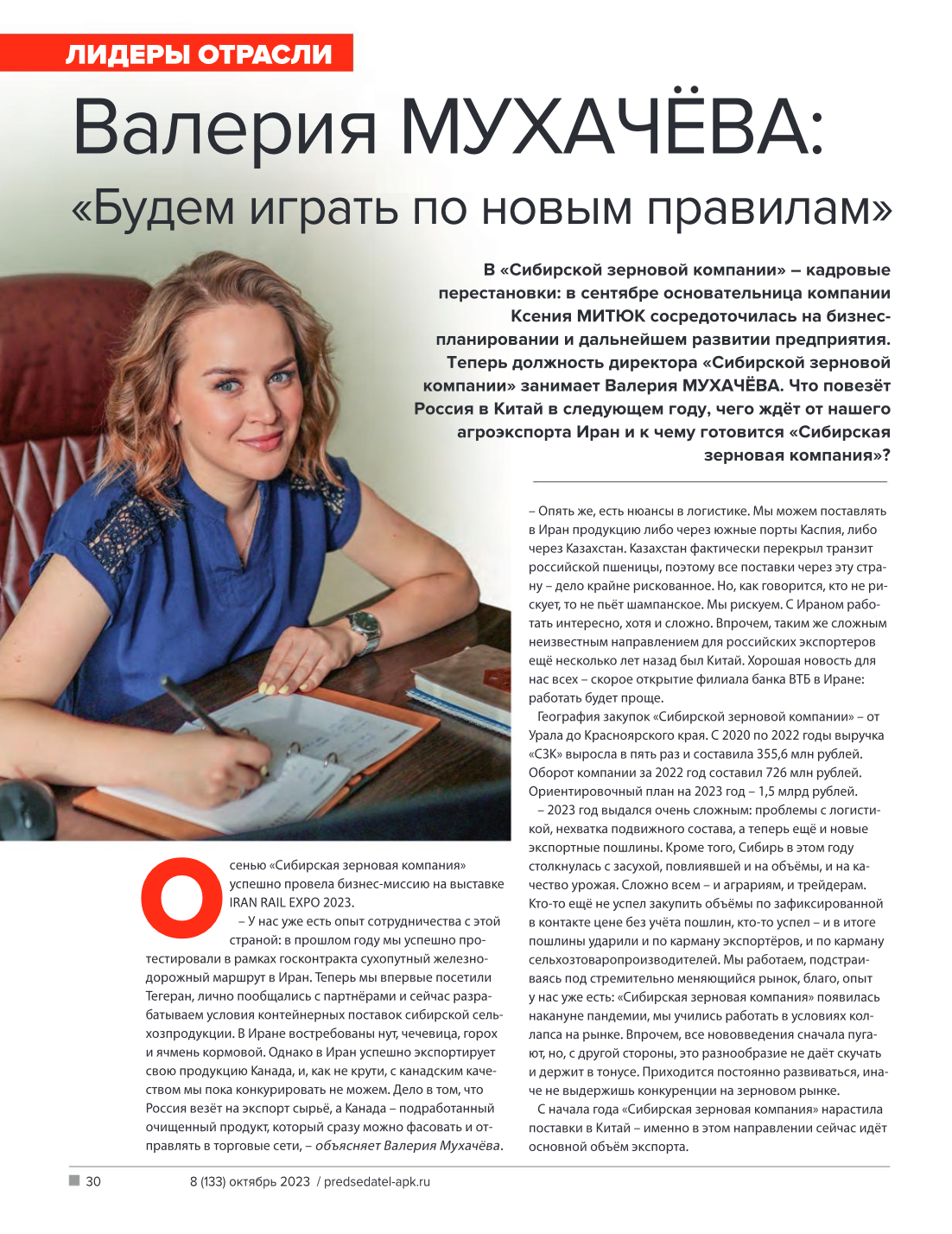
There are personnel changes at the Siberian Grain Company: in September, the company’s founder, Ksenia MITYUK, focused on business planning and further development of the enterprise. Now the position of director of the Siberian Grain Company is occupied by Valeria MUKHACHEVA. What will Russia bring to China next year, what does Iran expect from our agricultural exports, and what is the Siberian Grain Company preparing for?
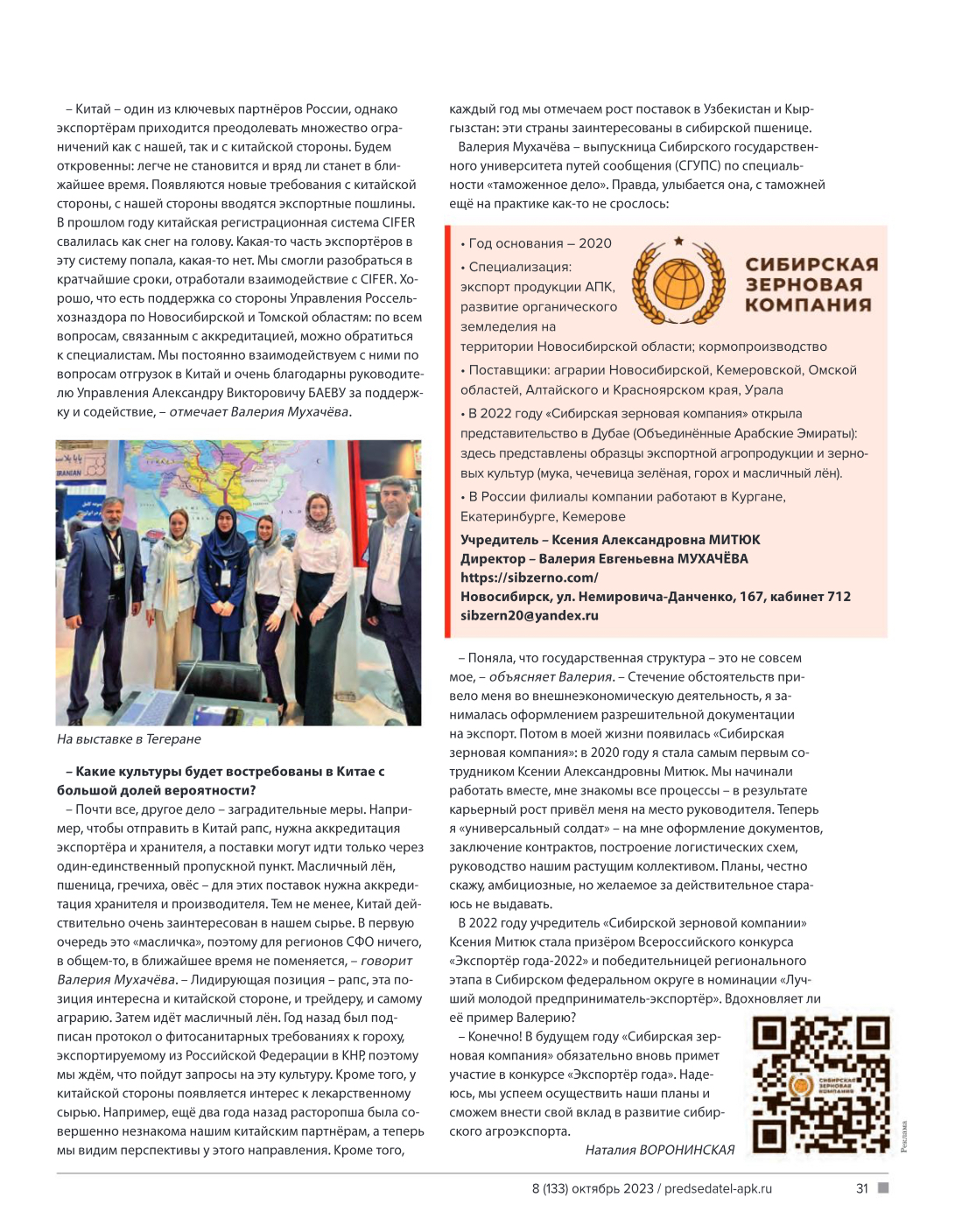
In the fall, the Siberian Grain Company successfully conducted a business mission at the IRAN RAIL EXPO 2023 exhibition.
- We already have experience of cooperation with this country: last year we successfully tested an overland railway route to Iran as part of a government contract. Now we have visited Tehran for the first time, personally communicated with partners and are now developing conditions for container deliveries of Siberian agricultural products. In Iran, chickpeas, lentils, peas and feed barley are in demand. However, Canada successfully exports its products to Iran, and, like everyone else, we cannot yet compete with Canadian quality. The fact is that Russia exports raw materials, and Canada exports a processed, purified product that can immediately be packaged and sent to retail chains, explains Valeria Mukhacheva.
- Again, there are nuances in logistics. We can supply products to Iran either through the southern ports of the Caspian Sea or through Kazakhstan. Kazakhstan has actually blocked the transit of Russian wheat, so all deliveries through this country are extremely risky. But, as they say, those who don’t take risks don’t drink champagne. We take risks. Working with Iran is interesting, although difficult. However, China was an equally complex unknown destination for Russian exporters just a few years ago. Good news for all of us is the imminent opening of a branch of VTB Bank in Iran: work will be easier.
The geography of purchases of the Siberian Grain Company is from the Urals to the Krasnoyarsk Territory. From 2020 to 2022, SZK’s revenue increased fivefold and amounted to 355.6 million rubles. The company's turnover for 2022 amounted to 726 million rubles. The tentative plan for 2023 is 1.5 billion rubles.
- 2023 turned out to be a very difficult year: problems with logistics, shortage of rolling stock, and now new export duties. In addition, Siberia faced drought this year, which affected both the volume and quality of the harvest. It is difficult for everyone - both farmers and traders. Someone has not yet managed to purchase volumes at the price fixed in the contact without taking into account duties, someone did - and as a result, duties hit both the pockets of exporters and the pockets of agricultural producers. We work, adapting to the rapidly changing market, fortunately, we already have experience: the Siberian Grain Company appeared on the eve of the pandemic, we learned to work in conditions of market collapse. However, all innovations are scary at first, but, on the other hand, this variety does not let you get bored and keeps you on your toes. You have to constantly develop, otherwise you won’t be able to withstand competition in the grain market.
Since the beginning of the year, the Siberian Grain Company has increased supplies to China - it is in this direction that the main volume of exports is now going.
- China is one of Russia’s key partners, but exporters have to overcome many restrictions from both our and the Chinese sides. Let's be honest: it's not getting any easier and it's unlikely to get any easier in the near future. New demands are emerging from the Chinese side, and export duties are being introduced on our side.
Last year, the Chinese registration system CIFER fell out of the blue. Some exporters got into this system, some did not. We were able to figure it out in the shortest possible time and worked out the interaction with CIFER. It’s good that there is support from the Rosselkhoznasdor Office for the Novosibirsk and Tomsk regions: you can contact specialists for all questions related to accreditation. We constantly interact with them on issues of shipments to China and are very grateful to the head of the Department, Alexander Viktorovich BAEV, for his support and assistance,” notes Valeria Mukhacheva.
- What crops are most likely to be in demand in China?
- Almost everything, another thing is the protective measures. For example, to ship rapeseed to China, you need accreditation of the exporter and custodian, and deliveries can only go through one single checkpoint. Oilseed flax, wheat, buckwheat, oats - these supplies require accreditation of the custodian and manufacturer. However, China is indeed very interested in our raw materials. First of all, this is a “maslichka”, so for the regions of the Siberian Federal District, nothing, in general, will change in the near future, says Valeria Mukhacheva. - The leading position is rapeseed; this position is of interest to both the Chinese side, the trader, and the agrarian himself. Then comes oilseed flax. A year ago, a protocol was signed on phytosanitary requirements for peas exported from the Russian Federation to China, so we are waiting for requests for this crop to come. In addition, the Chinese side is showing interest in medicinal raw materials. For example, two years ago milk thistle was completely unknown to our Chinese partners, but now we see prospects for this area. In addition, every year we note an increase in supplies to Uzbekistan and Kyrgyzstan: these countries are interested in Siberian wheat.
Valeria Mukhacheva is a graduate of the Siberian State University of Transport and Communications (SGUPS) with a degree in customs affairs. True, she smiles, things haven’t worked out with customs in practice yet:
“I realized that the state structure is not really my thing,” explains Valeria. - A coincidence of circumstances led me into foreign economic activity; I was involved in obtaining permits for export. Then the Siberian Grain Company appeared in my life: in 2020, I became the very first employee of Ksenia Aleksandrovna Mityuk. We started working together, I was familiar with all the processes - as a result, career growth brought me to the position of manager. Now I am a “universal soldier” - I am responsible for processing documents, concluding contracts, building logistics schemes, and managing our growing team. The plans, to be honest, are ambitious, but I try not to wishful thinking.
In 2022, the founder of the Siberian Grain Company, Ksenia Mityuk, became the winner of the All-Russian competition “Exporter of the Year 2022” and the winner of the regional stage 8 of the Siberian Federal District in the category “Best Young Entrepreneur-Exporter”. Does her example inspire Valeria?
- Certainly! Next year, the Siberian Grain Company will definitely take part in the Exporter of the Year competition again. I hope that we will have time to implement our plans and will be able to contribute to the development of Siberian agricultural exports.
Company information:
• Year of foundation - 2020
• Specialization: export of agricultural products, development of organic farming in the Novosibirsk region: feed production
• In 2022, the Siberian Grain Company opened a representative office in Dubai (United Arab Emirates): samples of export agricultural products and grain crops (flour, green lentils, peas and oilseed flax) are presented here.
• In Russia, the company’s branches operate in Kurgan, Yekaterinburg, Kemerovo
• Suppliers: farmers of the Novosibirsk, Kemerovo, Omsk regions, Altai and Krasnoyarsk territories, the Urals
Author of the article: Natalia VORONINSKAYA Journal Chairman
8 (133) October 2023 / predsedatel-apk.ru
Link to journal article
In the fall, the Siberian Grain Company successfully conducted a business mission at the IRAN RAIL EXPO 2023 exhibition.
- We already have experience of cooperation with this country: last year we successfully tested an overland railway route to Iran as part of a government contract. Now we have visited Tehran for the first time, personally communicated with partners and are now developing conditions for container deliveries of Siberian agricultural products. In Iran, chickpeas, lentils, peas and feed barley are in demand. However, Canada successfully exports its products to Iran, and, like everyone else, we cannot yet compete with Canadian quality. The fact is that Russia exports raw materials, and Canada exports a processed, purified product that can immediately be packaged and sent to retail chains, explains Valeria Mukhacheva.
- Again, there are nuances in logistics. We can supply products to Iran either through the southern ports of the Caspian Sea or through Kazakhstan. Kazakhstan has actually blocked the transit of Russian wheat, so all deliveries through this country are extremely risky. But, as they say, those who don’t take risks don’t drink champagne. We take risks. Working with Iran is interesting, although difficult. However, China was an equally complex unknown destination for Russian exporters just a few years ago. Good news for all of us is the imminent opening of a branch of VTB Bank in Iran: work will be easier.
The geography of purchases of the Siberian Grain Company is from the Urals to the Krasnoyarsk Territory. From 2020 to 2022, SZK’s revenue increased fivefold and amounted to 355.6 million rubles. The company's turnover for 2022 amounted to 726 million rubles. The tentative plan for 2023 is 1.5 billion rubles.
- 2023 turned out to be a very difficult year: problems with logistics, shortage of rolling stock, and now new export duties. In addition, Siberia faced drought this year, which affected both the volume and quality of the harvest. It is difficult for everyone - both farmers and traders. Someone has not yet managed to purchase volumes at the price fixed in the contact without taking into account duties, someone did - and as a result, duties hit both the pockets of exporters and the pockets of agricultural producers. We work, adapting to the rapidly changing market, fortunately, we already have experience: the Siberian Grain Company appeared on the eve of the pandemic, we learned to work in conditions of market collapse. However, all innovations are scary at first, but, on the other hand, this variety does not let you get bored and keeps you on your toes. You have to constantly develop, otherwise you won’t be able to withstand competition in the grain market.
Since the beginning of the year, the Siberian Grain Company has increased supplies to China - it is in this direction that the main volume of exports is now going.
- China is one of Russia’s key partners, but exporters have to overcome many restrictions from both our and the Chinese sides. Let's be honest: it's not getting any easier and it's unlikely to get any easier in the near future. New demands are emerging from the Chinese side, and export duties are being introduced on our side.
Last year, the Chinese registration system CIFER fell out of the blue. Some exporters got into this system, some did not. We were able to figure it out in the shortest possible time and worked out the interaction with CIFER. It’s good that there is support from the Rosselkhoznasdor Office for the Novosibirsk and Tomsk regions: you can contact specialists for all questions related to accreditation. We constantly interact with them on issues of shipments to China and are very grateful to the head of the Department, Alexander Viktorovich BAEV, for his support and assistance,” notes Valeria Mukhacheva.
- What crops are most likely to be in demand in China?
- Almost everything, another thing is the protective measures. For example, to ship rapeseed to China, you need accreditation of the exporter and custodian, and deliveries can only go through one single checkpoint. Oilseed flax, wheat, buckwheat, oats - these supplies require accreditation of the custodian and manufacturer. However, China is indeed very interested in our raw materials. First of all, this is a “maslichka”, so for the regions of the Siberian Federal District, nothing, in general, will change in the near future, says Valeria Mukhacheva. - The leading position is rapeseed; this position is of interest to both the Chinese side, the trader, and the agrarian himself. Then comes oilseed flax. A year ago, a protocol was signed on phytosanitary requirements for peas exported from the Russian Federation to China, so we are waiting for requests for this crop to come. In addition, the Chinese side is showing interest in medicinal raw materials. For example, two years ago milk thistle was completely unknown to our Chinese partners, but now we see prospects for this area. In addition, every year we note an increase in supplies to Uzbekistan and Kyrgyzstan: these countries are interested in Siberian wheat.
Valeria Mukhacheva is a graduate of the Siberian State University of Transport and Communications (SGUPS) with a degree in customs affairs. True, she smiles, things haven’t worked out with customs in practice yet:
“I realized that the state structure is not really my thing,” explains Valeria. - A coincidence of circumstances led me into foreign economic activity; I was involved in obtaining permits for export. Then the Siberian Grain Company appeared in my life: in 2020, I became the very first employee of Ksenia Aleksandrovna Mityuk. We started working together, I was familiar with all the processes - as a result, career growth brought me to the position of manager. Now I am a “universal soldier” - I am responsible for processing documents, concluding contracts, building logistics schemes, and managing our growing team. The plans, to be honest, are ambitious, but I try not to wishful thinking.
In 2022, the founder of the Siberian Grain Company, Ksenia Mityuk, became the winner of the All-Russian competition “Exporter of the Year 2022” and the winner of the regional stage 8 of the Siberian Federal District in the category “Best Young Entrepreneur-Exporter”. Does her example inspire Valeria?
- Certainly! Next year, the Siberian Grain Company will definitely take part in the Exporter of the Year competition again. I hope that we will have time to implement our plans and will be able to contribute to the development of Siberian agricultural exports.
Company information:
• Year of foundation - 2020
• Specialization: export of agricultural products, development of organic farming in the Novosibirsk region: feed production
• In 2022, the Siberian Grain Company opened a representative office in Dubai (United Arab Emirates): samples of export agricultural products and grain crops (flour, green lentils, peas and oilseed flax) are presented here.
• In Russia, the company’s branches operate in Kurgan, Yekaterinburg, Kemerovo
• Suppliers: farmers of the Novosibirsk, Kemerovo, Omsk regions, Altai and Krasnoyarsk territories, the Urals
Author of the article: Natalia VORONINSKAYA Journal Chairman
8 (133) October 2023 / predsedatel-apk.ru
Link to journal article